Rideshare Advertising on Uber and Lyft: Formats and Costs
Rideshare ads run on Uber and Lyft cars as digital tops, wraps and in-car tablets. Published rate cards put a digital top at $450 to $750 per four weeks.
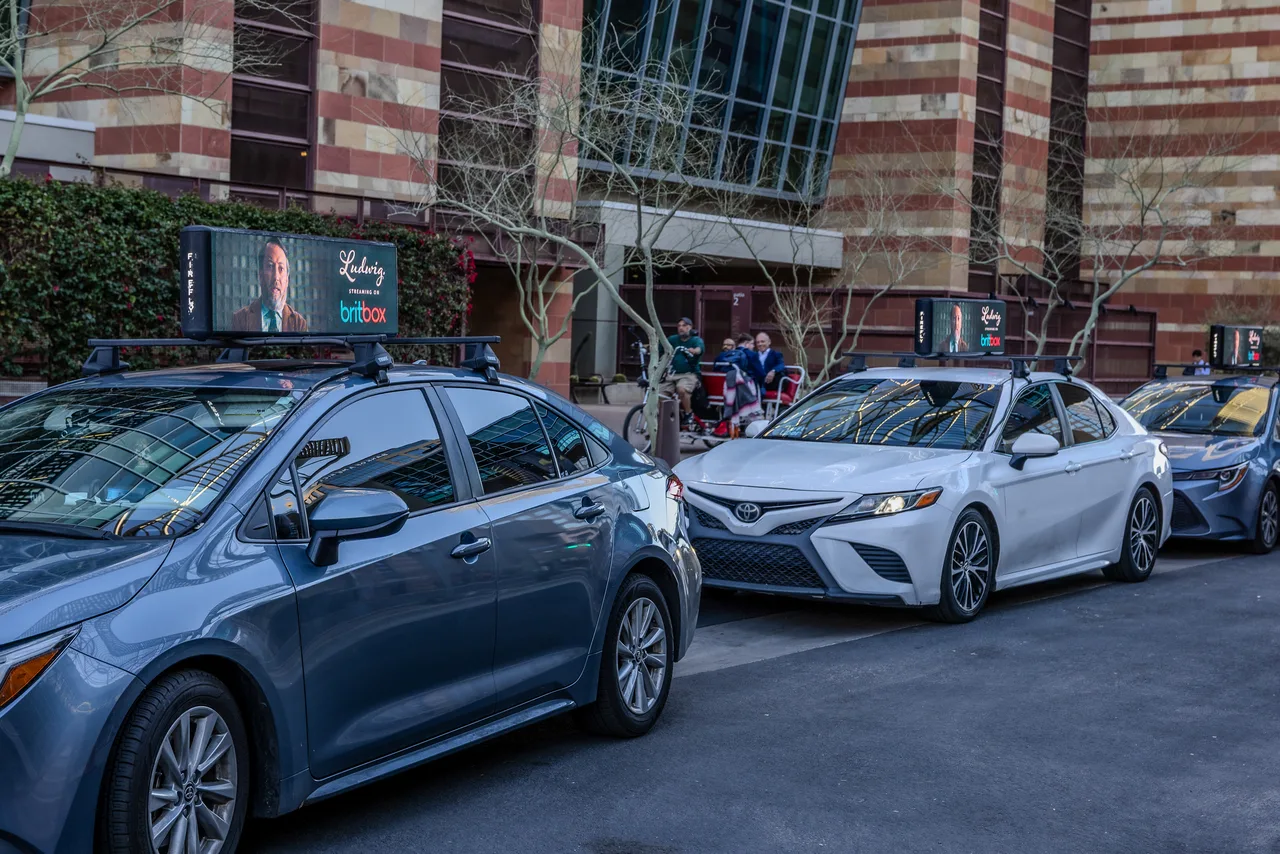
Rideshare advertising places paid media on or inside Uber and Lyft vehicles: digital rooftop displays, full or partial wraps, and rear-seat tablets. On Blue Line Media's published rate card (retrieved September 2026), a digital rideshare top lists at $450 to $750 per display per four-week cycle, with a $5,000 minimum per market.
That figure is one reseller's published range for its own inventory, read off Blue Line Media's taxi and rideshare page on 14 September 2026. The networks themselves quote per campaign and publish nothing. Everything else in this guide follows the same rule: a number appears only with the publisher and the date it was read.
What Is Rideshare Advertising?
It is out-of-home media carried by vehicles that are already circulating for another reason. A rideshare car spends its shift moving between airports, business districts, restaurants and residential streets, which is the same territory advertisers pay fixed boards to sit beside. The difference is that the car keeps meeting people a board never passes, and that the ad can be seen from the sidewalk and, for some formats, from the back seat.
The format's history is short and documented. Lyft bought the rooftop-screen startup Halo Cars in 2020 (TechCrunch, 8 August 2022), and T-Mobile bought the rear-seat screen network Octopus Interactive in January 2022 (The Drum, 10 January 2022). No one publishes a credible count of how many ad-carrying rideshare vehicles are on US roads, so treat any fleet figure you are quoted as a network's estimate of its own inventory, not a market total.
What Formats Can You Buy on a Rideshare Vehicle?
Four, and they behave differently enough that the format comparison treats rooftop and wrap as separate rows. Where a spec is stated below, it comes from the Blue Line Media page cited above.
Digital car tops are dual-sided screens mounted on the roof. They are the most visible format from the street, rotate several creatives, and can change content by location and time of day. Blue Line lists the digital top creative at 560 by 160 pixels (New York adds a 1920 by 674 file), JPG or MP4, up to eight seconds. The car top advertising guide covers this format end to end.
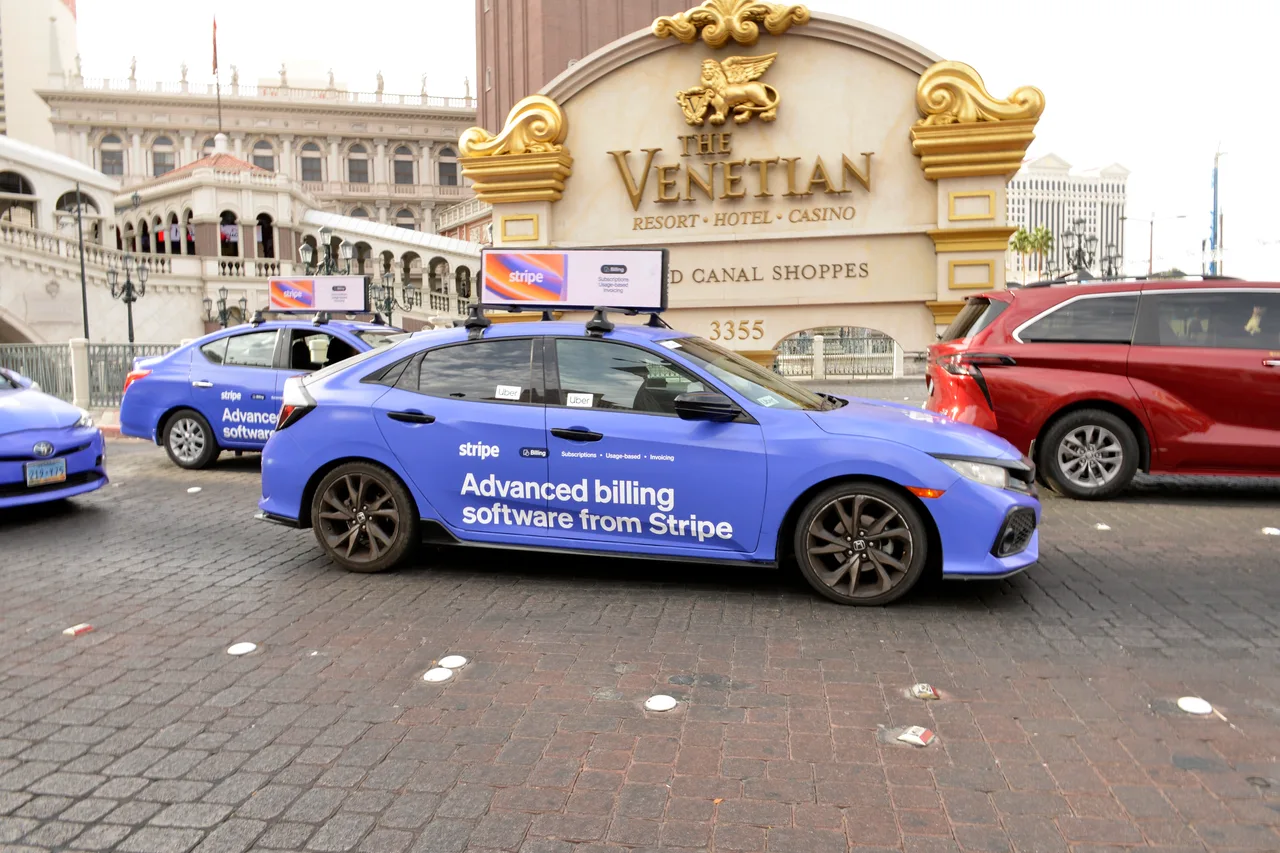
Exterior wraps apply printed vinyl to the doors, rear or full body. They work like any vehicle wrap, but a rideshare network handles recruitment, installation and campaign logistics, and the buy is priced per vehicle per four weeks rather than as a one-off production job.
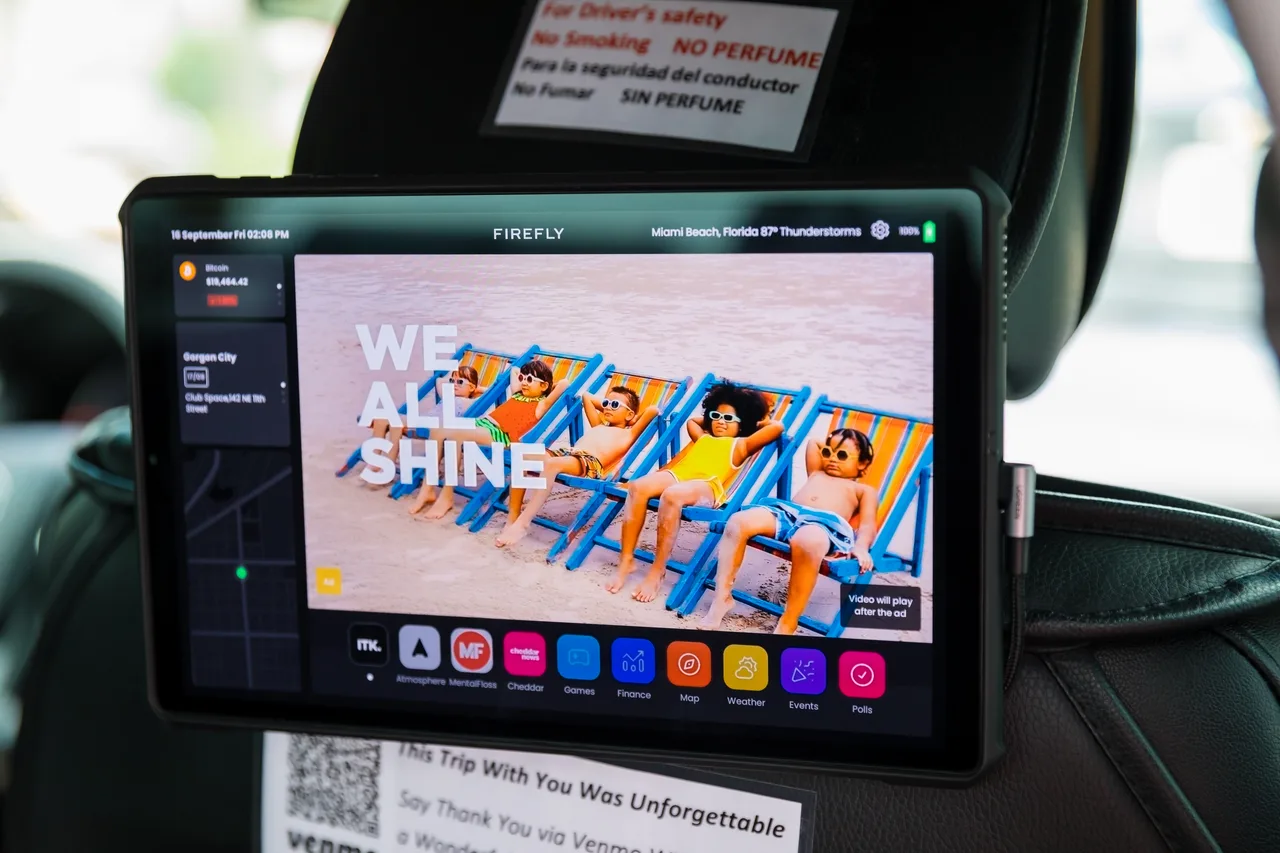
Rear-seat tablets face the passenger for the length of the trip. The audience is small per vehicle but close to the screen and not going anywhere, which is a different attention environment from any exterior format. Blue Line lists interior digital creative at 1920 by 1080 pixels, JPG or MP4, up to 30 seconds.
Printed interior pieces, seatback cards, branded chargers and samples, are the low-tech option for direct response. A QR code on a seatback card is scanned by someone who is sitting still, which is not true of any code on the outside of a moving car.
Who Sells Rideshare Advertising?
Six names cover most of the inventory. Counts below are the companies' own published figures, with the date they were published.
Firefly sells digital tops on taxi and rideshare vehicles, full-motion screens with built-in GPS, alongside static tops and 180, 270 and 360 wraps, per its on-car advertising page; its in-car page lists TaxiTV, a passenger screen with geo-fencing and day-parting. Its published network list names 15 markets: New York, Chicago, Los Angeles, San Francisco, Dallas, Las Vegas, Austin, Miami, Boston, Philadelphia, Atlanta, Phoenix, Washington DC, Houston and Toronto. Pricing is quoted per campaign and not published. An independent guide to Firefly advertising covers its formats, markets and published studies in full.
Lyft Media sells rooftop Halo screens, in-car tablets and in-app placements. Its launch announcement of 10 August 2023 reported 1,000-plus live Halo screens across five markets and 6,000 tablets across more than 12 markets. Those numbers are three years old; ask for current ones.
Uber Advertising sells JourneyTV, the in-car screen inside Uber vehicles, plus in-app formats. Uber's own 30 September 2025 post states a completion rate of close to 98 percent and average view time near 120 seconds per ride, and that JourneyTV reached New York City in June 2025. Both figures are vendor-reported and unaudited.
T-Mobile Advertising Solutions owns Octopus Interactive, whose rider-facing brand is Play Octopus. It is one company, not two, and it built the first large rear-seat screen network before the January 2022 acquisition.
Wrapify runs wraps on what its site describes as a network of 400,000-plus rideshare and delivery drivers, and sells attribution products that match wrap exposure to online and foot-traffic outcomes. No rate card.
Carvertise runs full and partial wraps with photo verification of wrap condition. Its advertiser page (retrieved September 2026) says it can run in any of the top 200 US markets plus Canada, off 300,000-plus contracted drivers, and names Coca-Cola, Planet Fitness, Wawa, Valvoline, Panda Express, Miller Lite and AAA among past clients. No rate card. The car wrap advertising companies post compares the wrap networks in more detail; the ranked list of car advertising companies scores eight networks on what they own and publish, and the Wrapify, Carvertise and Firefly comparison sets the three side by side.
How Is Rideshare Advertising Targeted?
Targeting is the practical difference between a digital top and a printed one. A digital top or tablet can be switched on inside a drawn polygon, a zip code, or a radius around a venue or a competitor, and off again outside it. Dayparting is standard on the same formats: a coffee brand runs one creative at 7 AM and another at 3 PM. A static wrap does none of this; it goes wherever the car goes, all day, with one message.
Some networks describe weather and event triggers. Ask for a written description of how the trigger works and how delivery inside the trigger window is reported before you pay for it.
How Much Does Rideshare Advertising Cost?
The ranges below are market-level figures compiled from publicly published vendor and industry sources. They are not quotes, and they are not the rates of any single network. Always get a written quote before budgeting.
| Format | Published range | Unit | Publisher, retrieved |
|---|---|---|---|
| Rideshare top, digital | $450–$750 | per display, per four-week period | Blue Line Media rate card, 14 September 2026 |
| Rideshare full wrap | $800–$1,500 | per display, per four-week period | Blue Line Media rate card, 14 September 2026 |
| Rideshare interior, digital | $800–$1,500 | per display, per four-week period | Blue Line Media rate card, 14 September 2026 |
| Taxi top, digital (for comparison) | $400–$600 | per display, per four-week period | Blue Line Media rate card, 14 September 2026 |
Blue Line Media is a reseller; the same page states a minimum purchase of $5,000 per market or higher, which may be spread over displays and periods, and says rates depend on timing and market. No methodology is published for the ranges.
Two cautions. First, these are one reseller's ranges for the inventory it resells, not a survey of the market. Second, networks that sell on a CPM basis count impressions differently from one another; before you compare a CPM to anything, ask how an impression is defined. The measured results page explains why CPMs in this category vary by more than an order of magnitude.
Does Rideshare Advertising Work?
Start with noticing. In the OAAA and Morning Consult Out of Home Advertising Study (1,461 US adults aged 18 to 64, fielded 10 to 15 November 2022, published March 2023), 22 percent of adults said they had noticed advertising on a ride-share vehicle, exterior or interior, in the previous 30 days, and 21 percent said the same of a taxicab. Wrapped vehicles and other vehicle signage scored 49 percent and billboards 69 percent. The rideshare-specific number is modest; the format is bought for where it goes, not for mass noticing.
Then look for campaign-level measurement by a named third party. In a published Firefly case study measured by LoopMe, a cosmetics brand running digital taxi and rideshare tops across Chicago, New York, Los Angeles and Miami recorded a 43 percent lift in brand awareness, 44 percent in brand recall, 46 percent in favorability and 85 percent in purchase intent against control, on 39,981,921 impressions delivered against a 30,000,000 target.
Firefly has also published two studies with the out-of-home measurement firm Reveal. The first, released in October 2025, found that combining moving and stationary out-of-home lifted campaign performance by 50 to 100 percent against stationary alone. The second, The Amplifying Effect, Part II (6 May 2026), reports that moving out-of-home produced up to 2.8 times greater growth in unique reach relative to impression growth, and that digital car tops delivered 60 to 80 percent greater unique audience reach than stationary formats at equivalent impression levels. Reveal ran the analysis on deduplicated mobile location data.
A separate case study measured by Foursquare recorded a 9.31 percent behavioral lift for a convenience store chain. That is a smaller number than the brand-metric lifts above, and a more typical picture of what footfall attribution looks like.
Wrap and tablet vendors circulate headline figures too, usually without a method attached. Ask for the study itself: how many vehicles, over what period, in which markets, measured by whom, against what control. If the answer is a one-page PDF with a big number on it, that is a brochure, not a study.
Is Rideshare Advertising Right for Your Brand?
It fits brands that need urban reach, want to concentrate on specific neighborhoods, and will pay for a measurement study alongside the media. Consumer launches, app installs, entertainment openings and multi-location retailers in dense metros are the usual buyers, and the campaign archive shows who has actually run it.
It fits less well for rural audiences, for narrow B2B buyer profiles, and for advertisers who need guaranteed frequency against a small audience. The strength of a fleet is breadth: it keeps meeting new people. Depth is what a fixed board on your customer's commute is for.
If you buy, start with one market, run at least one full four-week cycle, and insist on a brand lift study against a matched control or footfall attribution from a named third party before deciding whether to scale.
Frequently Asked Questions
How much does it cost to advertise on Uber and Lyft vehicles?
On Blue Line Media's published rate card, retrieved September 2026, a digital rideshare top lists at $450 to $750, a full wrap at $800 to $1,500 and an interior screen at $800 to $1,500, each per display per four-week period, with a $5,000 minimum per market. The networks themselves quote per campaign and do not publish rates.
What formats does rideshare advertising include?
Four: digital rooftop displays, full or partial vinyl wraps, rear-seat tablet screens, and printed interior pieces such as seatback cards. Rooftop and wrap formats reach people outside the car; tablets and interior pieces reach the passenger for the length of the trip.
Which companies sell advertising on rideshare vehicles?
Lyft Media and Uber Advertising sell placements on their own vehicles and apps. T-Mobile Advertising Solutions owns the Octopus Interactive rear-seat screen network. Wrapify and Carvertise run wrap campaigns on rideshare and delivery drivers' cars. Firefly operates digital car tops in 15 listed markets.
Can rideshare ads be targeted by location and time of day?
Digital tops and in-car tablets can be switched on inside a defined zone and scheduled by daypart, so one creative runs in the morning and another in the evening. Static wraps cannot; a wrapped car shows one message wherever it drives.
How is a rideshare advertising campaign measured?
The credible measures are brand lift studies against a matched control, footfall attribution from a location-data provider, and deduplicated reach analysis. Published Firefly studies used LoopMe, Foursquare and Reveal respectively. Impression counts on their own are modeled estimates and vary with the counting method.
Do people notice ads on rideshare vehicles?
In the OAAA and Morning Consult study published in March 2023, 22 percent of US adults aged 18 to 64 said they had noticed an ad on a ride-share vehicle in the past 30 days, against 49 percent for wrapped vehicles and 69 percent for billboards. The format is bought for where it goes, not for mass noticing.
Is rideshare advertising allowed in New York City?
New York City's traffic rules (34 RCNY 4-12(j)) prohibit operating, standing or parking a vehicle on a street for the purpose of commercial advertising, with an exception for vehicles licensed by the Taxi and Limousine Commission under its own advertising rules. Ask any network what license its New York vehicles carry before you book that market.
What to send us
- Market, or markets
- Dates, or flight length
- Budget band
- The metric you will judge it by
A person replies with a written range and the formats that fit. No rate card exists; every number on this site is a published third-party figure.
Send the briefSources
- Blue Line Media, Taxi and Rideshare Advertising rate card and specs, retrieved 14 September 2026. bluelinemedia.com/taxi-advertising
- OAAA and Morning Consult, Out of Home Advertising Study, March 2023 (fielded 10 to 15 November 2022, n=1,461). oaaa.org
- Lyft, Lyft Media launches in-app advertising, expands tablets, rooftop and bikeshare stations, 10 August 2023. lyft.com/blog
- Uber Advertising, JourneyTV Presents launch post, 30 September 2025. uber.com/blog
- The Drum, T-Mobile enters rideshare advertising market with the acquisition of Octopus, 10 January 2022. thedrum.com
- TechCrunch, Lyft creates media division to cash in on in-car ads, 8 August 2022. techcrunch.com
- Carvertise, Advertise With Us, retrieved September 2026. carvertise.com
- Wrapify, homepage, retrieved September 2026. wrapify.com
- Firefly, case study measured by LoopMe; Firefly and Reveal, The Amplifying Effect, Part II, 6 May 2026; Firefly case study measured by Foursquare. fireflyon.com
- Rules of the City of New York, Title 34, Section 4-12(j), commercial advertising on vehicles. codelibrary.amlegal.com
Written by
Melih Koray is a marketing and SEO practitioner who documents out-of-home media. He edits this site, sources every figure on it and checks each campaign caption against the photograph. He does not publish unsourced numbers, and he does not publish any operator's rate card.