Event Advertising: What Reaches People Outside the Venue
Promoters sell the inside of the venue. Arrival routes, parking, transit and hotels outside it are vehicle and OOH inventory. Who sells each, and the cost.
Event advertising is two markets. Inside the venue, the promoter or venue sells signage, screens, booths and sponsorship tie-ins, usually bundled and usually exclusive. Outside it, the arrival routes, parking lots, transit hubs and hotel corridors are sold by out-of-home and vehicle operators, by the truck-day or the four-week period, to any brand with a permit.
This page is for a brand that wants to reach the people going to a game, a conference or a festival, not the organiser trying to sell tickets. The search results for this term are almost all about the second job. The first job has a different vendor list, a different clock and a different set of city rules, and the perimeter is where vehicles do the work that fixed signage cannot.
Who sells the inside of the venue, and who sells the perimeter?
Inside inventory belongs to whoever controls the building or the field. Blue Line Media's event and festival page is a fair inventory of what that means when resold: booths, displays, exhibit space, in-stadium promotions and signage, sponsorship tie-ins and give-aways, with banners, stage signage, digital screens, fence and entryway signage, wristbands, tickets and sampling zones listed in its own FAQ. All of it is bought from or through the organiser, priced on request, and often closed to competitors of the event's sponsors.
Outside inventory belongs to whoever controls the street. Fixed formats near a venue, bus shelters, transit and airport panels, roadside faces, are sold by the OOH contract holders in that market. Moving formats are sold by operators: LED and printed billboard trucks, wrapped taxi and rideshare cars running as a swarm, pedicabs, food and glass trucks parked where the crowd walks. Of the operators, Firefly sells coordinated swarms, LED digital trucks, glass trucks, 3D hologram trucks and branded food trucks on the network that runs its taxi and rideshare tops; Billboard Express and Bulldog Mobile Billboards sell printed and LED trucks; Blue Line Media resells trucks and pedicabs. The format comparison sets these side by side. The table below is the map of who owns which zone.
| Zone | Inventory | Who sells it | Unit | Constraint |
|---|---|---|---|---|
| Inside the venue | Signage, screens, booths, sampling zones, wristbands, programmes | Venue, promoter, organiser; resellers such as Blue Line Media | Sponsorship package, per event | Category exclusivity; organiser approval of creative |
| Gates and plaza | Handouts, sampling, signs carried in | Venue only, by permission | Per event | Venue policy; unapproved advertisements are prohibited items at Ball Arena, for example |
| Arrival routes | LED and printed trucks, taxi and rideshare swarms, pedicabs | Vehicle operators | Per truck per 8-hour day; per vehicle per 4 weeks | City vehicle-advertising rules; event clean zones |
| Parking lots | Trucks driven through, parked trucks where the lot owner allows | Vehicle operators, lot owner | Per truck per day | Private property permission; some lots are venue-controlled |
| Transit hubs and airports | Station panels, bus exteriors, airport displays, wrapped taxis at ranks | OOH contract holders; taxi networks | Per face per 4 weeks; per vehicle per 4 weeks | Fixed inventory books early; production lead times |
| Hotel and convention corridors | Wrapped cars and digital tops circulating between hotels and the hall | Car-top and rideshare networks | Per vehicle per period, route-scheduled | Taxi licensing regime decides what may be carried |
When does the window open and close?
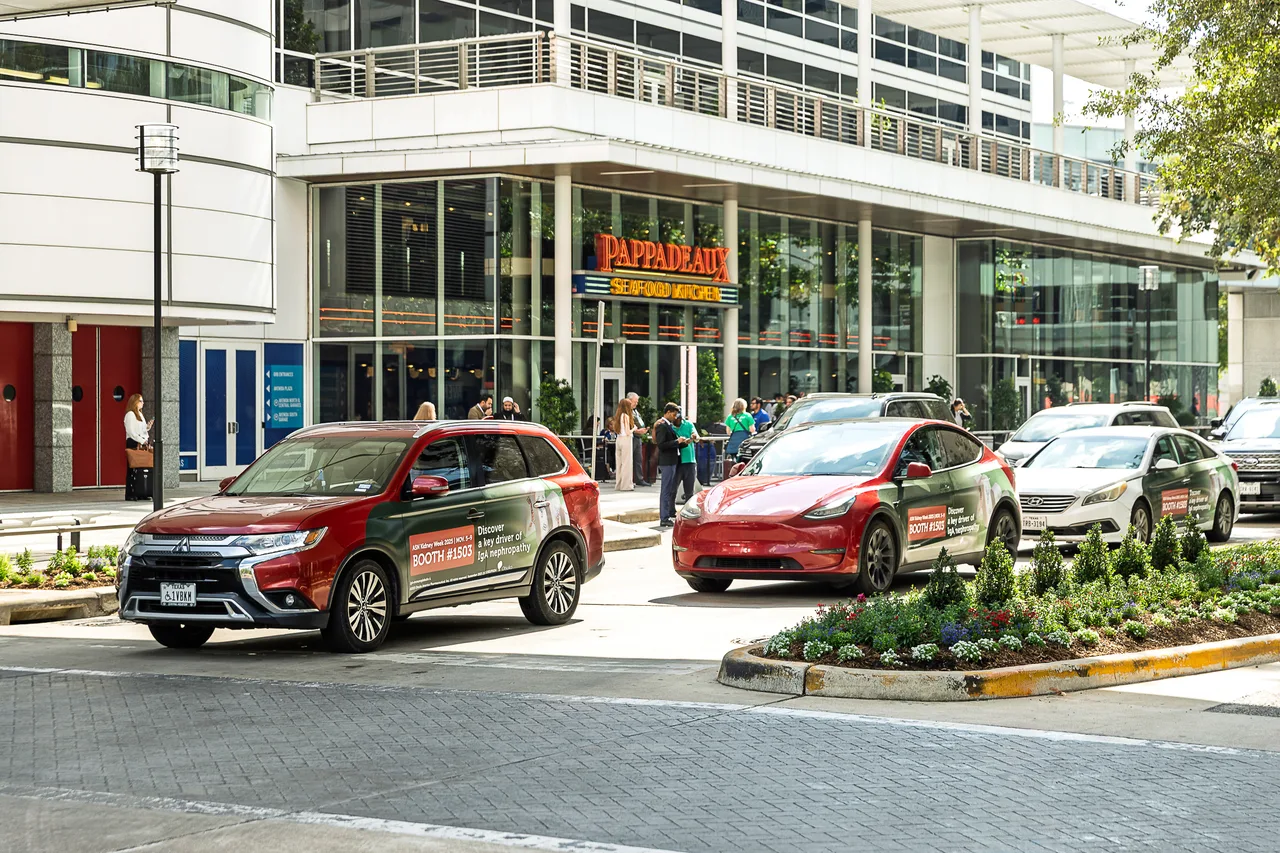
The window runs from load-in to load-out, not from doors to encore. For a conference that is the full run of show plus the travel days on either side: NVIDIA GTC in Washington DC ran 27 to 29 October 2025 at the Walter E. Washington Convention Center, which gives a vehicle operator three days of hotel-to-hall traffic and two of arrivals and departures. For a medical congress it is similar: ASN Kidney Week 2025 ran 5 to 9 November in Houston, and the wrapped cars in the frame below carried a booth number, which only pays off while the exhibit hall is open.
For a game the window is shorter and sharper: the hours before tip-off on the walk from the parking structures and the transit stop, then the hours after. For a festival it is the whole run plus the road closures, which push foot traffic onto a handful of streets that a pedicab or a wrapped car can cover end to end. The longest windows are the ones the city itself defines. New Orleans set its Super Bowl LIX clean zone at nine days, from 6 a.m. on 3 February to 11:59 p.m. on 11 February 2025, per Verite News; that is the outer bound of the commercial window as well as the restriction, because it is when the host committee expects the crowd.
What permits and restrictions apply around venues?
Three layers, and each has a published rule you can read. The city decides whether an advertising vehicle may stand on its streets at all. Los Angeles Municipal Code Section 87.53 makes it unlawful to park a mobile billboard advertising display, defined through California Vehicle Code 395.5 as a sign on a non-motorised vehicle, device or bicycle whose primary purpose is advertising, on any public street or public land, with removal after a warning citation. Its neighbour, Section 87.54, covers motor vehicles: a parked vehicle may only carry advertising that is painted on, applied as a decal, or in a manufacturer-designed location, within the vehicle's own length, width and height, and after an initial warning a further offence is a misdemeanour carrying a fine of $250 to $1,000. A truck with a bolted-on screen, parked, is what that rule was written for. A wrapped car in service, or a truck that keeps moving, is not.
New York draws the line by licence. Traffic rule 34 RCNY 4-12(j)(1) prohibits operating, standing or parking a vehicle on any street for the purpose of commercial advertising, allows business notices on a vehicle in normal use provided nothing is reflective, illuminated, animated or on the roof, and then exempts vehicles licensed by the Taxi and Limousine Commission under the Commission's rules and franchised buses. In New York the perimeter play is therefore taxis, licensed for-hire cars and buses, and the truck-with-a-screen is the format to ask hard questions about.
The event adds its own layer. For Super Bowl LIX the New Orleans City Council unanimously approved a clean zone on 10 October 2024 covering the Central Business District, French Quarter, Treme and Tulane-Gravier, including the Superdome, the Smoothie King Center and the convention centre, with restrictions on commercial activity such as promotional giveaways and a stated purpose of protecting the event from ambush marketing and conflicting signage. The venue closes the loop at the door: Ball Arena's published prohibited items include unapproved pamphlets, handouts, advertisements and stickers, and signs larger than 11 by 17 inches. Everything up to that door is negotiable; everything past it belongs to the building.
Sports event advertising: what the archive shows
Two frames from the campaign archive show the perimeter working at the two extremes of scale. The first is a city-wide event whose venue was almost beside the point.
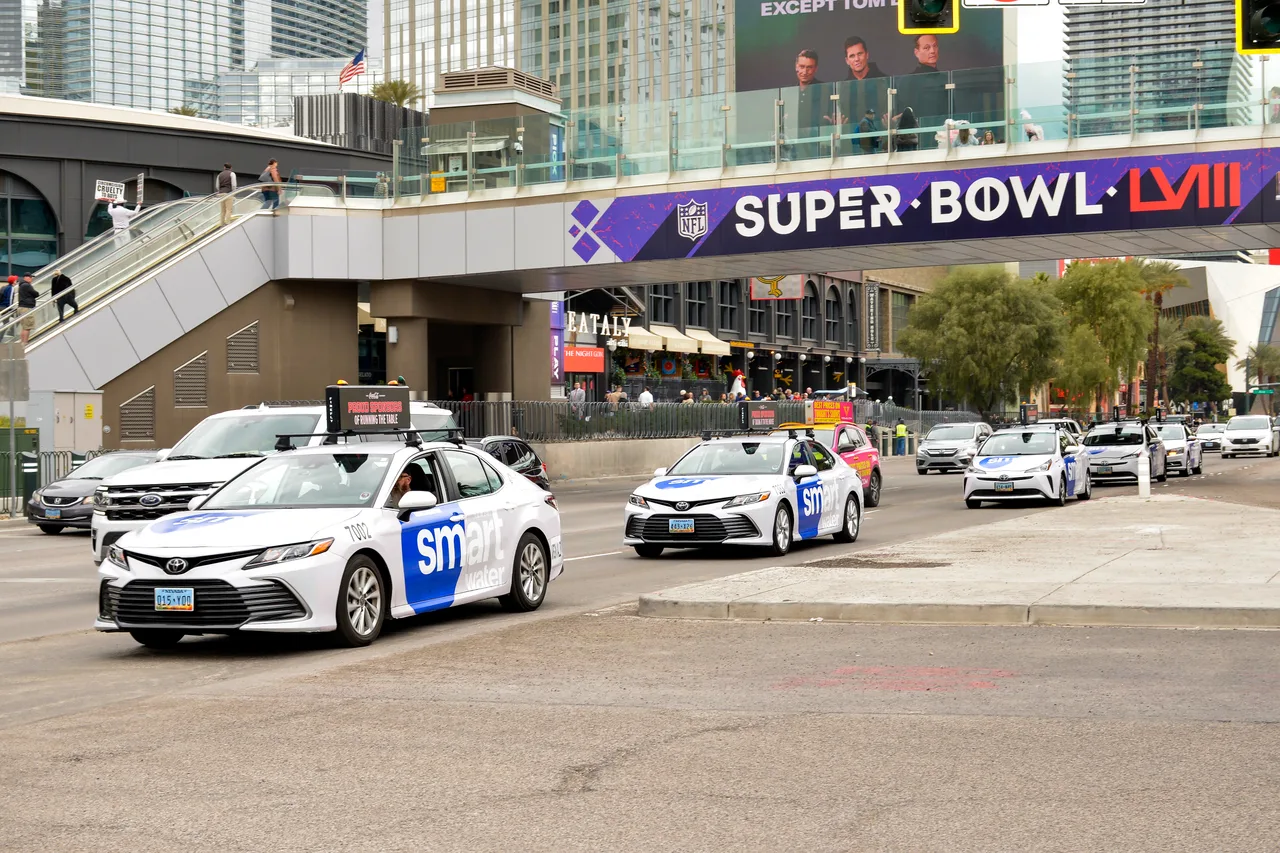
Super Bowl LVIII was played on 11 February 2024 at Allegiant Stadium, but the crowd spent the week on the Strip, and the frame catches the taxis running as a group beneath the NFL's own bridge wrap. That is the perimeter at its widest: the whole resort corridor is the arrival route. The second frame is the perimeter at its narrowest, the last hundred metres of a walk to a door.
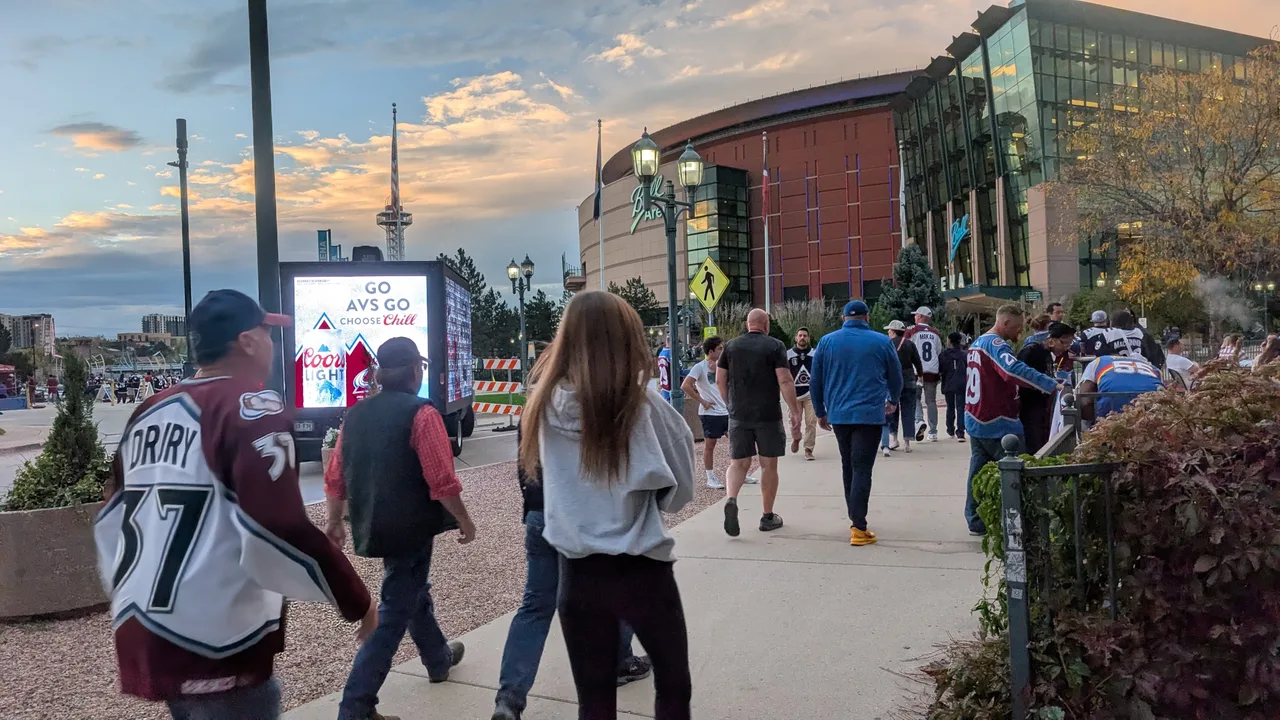
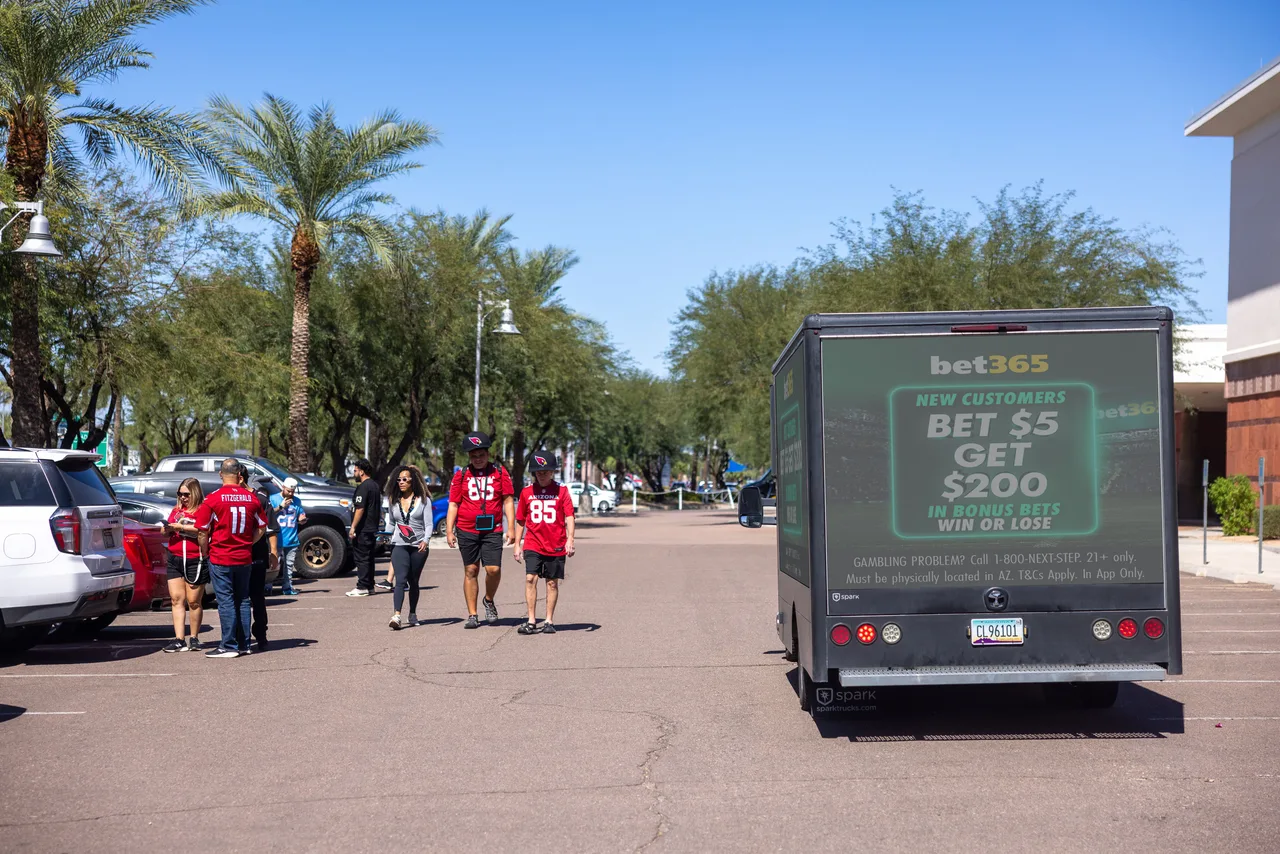
The truck sits on the approach, facing the direction the fans walk, at the hour they walk it. The creative names the team the crowd is wearing. Inside the building the beer category is somebody's sponsorship; on the pavement outside it is a truck-day. The frame at the top of this page is the same idea in a parking lot, a bet365 LED truck rolling through a parking area past people in Cardinals jerseys in Phoenix, with the Arizona gambling disclaimer printed on the screen. The LED truck guide covers how those days are bought.
Concert advertising and festival advertising: where is the perimeter?
A search for festival advertising returns award shows, the New York Festivals and Cannes Lions, ahead of anything about reaching festival crowds, which tells you how thin the published material is. For a multi-day festival the perimeter is defined by the road closures. During SXSW, which ran 12 to 18 March 2026 in Austin, badge holders move between venues on foot through closed streets, and the archive holds a branded pedicab carrying two badged passengers past a road-closed sign, on the closed street where the cars are not. For a concert at an arena the perimeter is the arena's own: the transit stop, the parking structures, the bars on the walk. For a fan zone the perimeter is the block. Ryder Cup Live occupied Rockefeller Center from 25 to 28 September 2025, and the archive frame from that week shows four wrapped SUVs marked as courtesy cars lined up on the street beside it, with the Ryder Cup Live structure in the background: vehicles as the sponsor's presence outside a space the sponsor did not control.
Concert advertising has one more wrinkle. The promoter's inside inventory is usually exclusive to the tour's sponsors, and the artist's own campaign often sits on the digital tops outside, as the BTS frame in the guerrilla post shows. Both groups are buying the same perimeter, one to sell tickets and one to sell to ticket-holders. The guerrilla marketing examples post has the photographed versions of both, and the ranked experiential marketing companies post scores the operators who sell those vehicles on fleet and named markets.
How is event advertising measured?
Not by the industry's standard currency. Geopath's glossary describes its ratings as built from audited inventory locations and circulation data adjusted by visibility research, and defines a mobile billboard as a truck with poster panels that can be parked at specified venues or driven around designated localities. There is no Geopath rating for a truck on an arena walkway on one night, because the walkway is not an audited inventory location and the crowd is not the road's normal traffic. Any impression figure a vendor attaches to an event perimeter is the vendor's model.
What can be measured is exposure at the device level: which phones were near the vehicle during the window, and what those devices did afterwards against a matched control. That is the method behind the lift and reach studies collected on the results page, and it is the only standard worth writing into an event contract. Ask for the measurement partner's name, the control design and the study method before the event, not after.
What do event vehicle placements cost?
Two operators publish rates for the moving formats, and they price the same product differently: one by a range per truck-day, the other by the hour with a minimum. Inside-venue inventory is priced on request by every seller checked for this page, so it does not appear here.
The ranges below are market-level figures compiled from publicly published vendor and industry sources. They are not quotes, and they are not the rates of any single network. Always get a written quote before budgeting.
| Format | Published rate | Unit and minimum | Publisher, date checked |
|---|---|---|---|
| Mobile billboard truck, static print | $1,200 to $5,000 | Per truck per 8-hour period; $5,000 minimum per market | Blue Line Media, September 2026 |
| Mobile billboard truck, digital | $1,200 to $5,000 | Per truck per 8-hour period; $5,000 minimum per market | Blue Line Media, September 2026 |
| Digital LED billboard truck, single day | $175 per hour | Minimum 8 hours per day; sole advertiser, three sides | Billboard Express, September 2026 |
| Digital LED billboard truck, week | $7,500 | Per week, 5 days at 8 hours | Billboard Express, September 2026 |
| Digital LED billboard truck, month | $24,000 | Per month, 5 days a week at 8 hours | Billboard Express, September 2026 |
| Pedicab, full wrap or side banners | $300 to $600 | Per display per 4 weeks; $5,000 minimum per market | Blue Line Media, September 2026 |
Read the units first. Billboard Express's hourly rate with its eight-hour minimum comes to $1,400 for a day, which sits at the bottom of Blue Line's $1,200 to $5,000 range for the same eight hours; the top of that range is where event weeks live, because a truck on the Strip in Super Bowl week is not priced like a truck in a suburb in March. Blue Line's $5,000 per-market minimum means a single truck-day rarely clears on its own. Neither publisher states an event surcharge, so ask for the date-specific number in writing. The mobile billboard strategies post covers routing and the agency guide covers who is marking these rates up.
How do you plan an event perimeter buy?
- Draw the perimeter from the crowd's route, not the venue's address: transit stop, parking structures, hotel cluster, closed streets.
- Check the city rule for each vehicle type before choosing the format: LAMC 87.53 and 87.54 in Los Angeles, 34 RCNY 4-12(j) in New York, and the equivalent where you are buying.
- Ask the host committee whether a clean zone ordinance exists, its dates and its boundary, and get the operator's permit plan in writing.
- Set the window by load-in to load-out and price it by the day, then compare against a four-week vehicle buy that covers the same streets before and after.
- Name the measurement partner and the control design in the contract; refuse impression estimates as a deliverable.
- Require dated photographs from the perimeter itself. The archive on this site is the standard: brand, format, city, year, visible in the frame.
Frequently Asked Questions
What is event advertising?
Event advertising is paid media placed around a live event to reach its audience. It has two halves: inside-venue inventory such as signage, screens, booths and sampling zones sold by the venue or promoter, and outside-venue inventory such as billboard trucks, wrapped vehicles, pedicabs and transit panels sold by out-of-home and vehicle operators along the arrival routes.
What is the best way to advertise at an event without being a sponsor?
Buy the perimeter. Sponsorship packages control the inside of the venue and are usually category-exclusive, but the streets, parking areas, transit stops and hotel corridors are sold by vehicle and OOH operators to any brand that complies with city rules and any event clean zone. Time the buy from load-in to load-out rather than around the event itself.
Is it legal to park an advertising truck outside a stadium?
It depends on the city. Los Angeles Municipal Code 87.53 prohibits parking a non-motorised mobile billboard display on any public street, and 87.54 limits advertising on parked motor vehicles to paint, decals or manufacturer-designed locations. New York's 34 RCNY 4-12(j) prohibits standing or parking a vehicle on a street for commercial advertising, with exemptions for TLC-licensed vehicles and franchised buses. Private lots need the owner's permission.
What is a clean zone?
A clean zone is a temporary ordinance a host city passes around a major event to restrict commercial activity, signage and promotional giveaways in a defined area for a defined period, mainly to prevent ambush marketing. New Orleans approved a nine-day clean zone for Super Bowl LIX, from 3 to 11 February 2025, covering the Central Business District, French Quarter and surrounding neighbourhoods.
How much does a billboard truck cost for an event day?
Published third-party rates run from $1,200 to $5,000 per truck per eight-hour period at Blue Line Media, with a $5,000 minimum per market, and $175 per hour with an eight-hour minimum at Billboard Express, both checked in September 2026. Neither publishes an event-week surcharge, so the date-specific quote is the only number to budget from.
How is advertising outside an event measured?
Not by Geopath, whose ratings are built from audited fixed inventory locations and circulation data rather than from a temporary perimeter. The workable method is device-level exposure: which mobile devices were near the vehicles during the window and how their behaviour compared with a matched control group afterwards, run by a named measurement partner.
What are examples of sports event advertising outside the venue?
The campaign archive on this site holds a line of smartwater-wrapped taxis under a Super Bowl LVIII bridge wrap on the Las Vegas Strip in 2024, a Coors Light LED truck on the walkway outside Ball Arena as Avalanche fans arrived in 2025, and a bet365 LED truck moving through a parking area past people in Cardinals jerseys in Phoenix. Each is a placement on the approach, timed to the arrival.
What to send us
- Market, or markets
- Dates, or flight length
- Budget band
- The metric you will judge it by
A person replies with a written range and the formats that fit. No rate card exists; every number on this site is a published third-party figure.
Send the briefSources
- Blue Line Media. Event, Festival and Fair Advertising; Mobile Billboard Truck Advertising rates; Pedicab Advertising rates, all accessed 14 September 2026.
- Billboard Express. Mobile Billboard Truck Advertising Rates, accessed 14 September 2026.
- NVIDIA. GTC Washington, D.C. 2025 Travel and Venue; American Society of Nephrology. Kidney Week 2025, both accessed 14 September 2026.
- Katie Jane Fernelius. Council approves a nine-day clean zone for the Super Bowl, Verite News, 10 October 2024.
- City of Los Angeles. LAMC Sec. 87.53, Regulation of Mobile Billboard Advertising Displays and Sec. 87.54, Regulation of Advertising Signs on Motor Vehicles Parked or Left Standing, accessed 14 September 2026.
- City of New York. 34 RCNY 4-12(j), Commercial advertising vehicles, accessed 14 September 2026.
- Ball Arena. Prohibited Items, accessed 14 September 2026.
- Allegiant Stadium. Super Bowl LVIII, accessed 14 September 2026.
- SXSW. SXSW 2026 Schedule; PGA of America. Ryder Cup Live Bringing Bethpage Black to the Heart of New York, 3 September 2025.
- Geopath. Glossary, accessed 14 September 2026.
Written by
Melih Koray is a marketing and SEO practitioner who documents out-of-home media. He edits this site, sources every figure on it and checks each campaign caption against the photograph. He does not publish unsourced numbers, and he does not publish any operator's rate card.